
Messi Returns to South America as Inter Miami Announces a Three-Country Preseason Tour
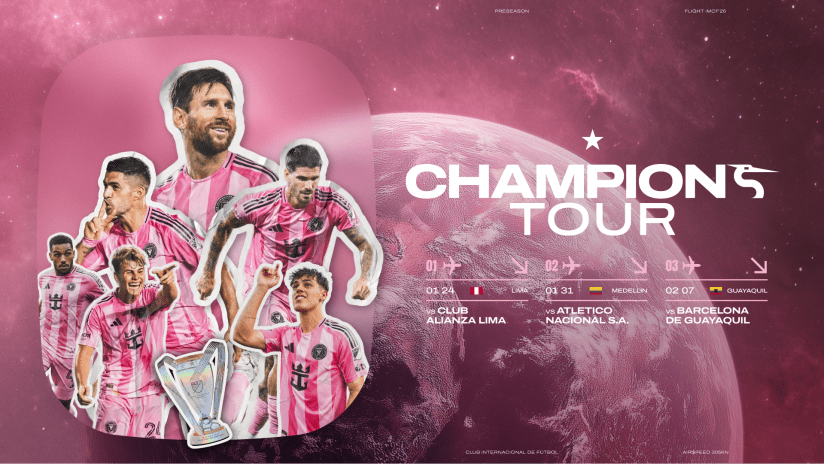
According to official channels of Inter Miami, the club whose most visible shareholder is David Beckham and which features World Cup champion Lionel Messi, the institution has officially announced its South American Tour 2026, a preseason tour that will include three countries: Peru, Colombia, and Ecuador. The tour will begin on January 24 in Lima, where Inter Miami will face Alianza Lima, continue on January 31 in Medellín against Atlético Nacional, and conclude on February 7 in Guayaquil, at the Monumental Stadium, against Barcelona Sporting Club.
The choice of these dates aligns with the international football calendar. January and February offer an ideal window, as many South American leagues are either in recess or preseason, reducing competitive pressure and allowing friendly matches to be played with greater tactical freedom. For Inter Miami, this tour serves as a key preparation phase ahead of the official season, with controlled physical loads and without the urgency of competitive results.
These matches also provide an ideal platform to test new signings, evaluate tactical options, and observe the performance of young or recently added players. Without points at stake, the coaching staff can adjust systems, assess chemistry between new and existing players, and begin shaping the team’s identity. For many players, the tour represents an opportunity to showcase their abilities not only to coaches and fans, but also to agents and international markets.
Beyond current sporting form, Alianza Lima, Atlético Nacional, and Barcelona Sporting Club share a key trait: they are clubs with massive fan bases and deep historical significance in their respective countries. Inter Miami’s selection is not driven by recent titles, but by crowd-drawing power, cultural relevance, and generational loyalty. These are institutions that guarantee full stadiums, strong media attention, and narratives deeply rooted in local football culture.
Social Dynamics of Football
This type of tour confirms that contemporary football operates far beyond strictly competitive logic. As noted by several scholars of sport and culture, including Christian Bromberger and David Goldblatt, clubs and global stars no longer simply play matches; they activate collective rituals, emotional markets, and shared memories. In this context, stadiums become symbolic stages where results are secondary to experience, identity, and the connection between generations of fans who recognize these events as a continuation of their footballing history.
In Ecuador’s case, the visit to Guayaquil’s Monumental Stadium reinforces this logic. Barcelona Sporting Club, despite not being in its strongest sporting moment, remains the most popular team in the country and a symbol of Ecuadorian football. Messi’s presence transcends club rivalries: his figure generates widespread admiration and turns the match into an event that goes beyond the final score, appealing to emotion, memory, and the shared experience of football.
Inter Miami’s South American tour represents far more than a series of friendly matches. It is a strategy of brand expansion, a tribute to historically loyal fan bases, and possibly one of the last opportunities to see Lionel Messi perform in iconic stadiums across the continent. A tour that blends spectacle, business, and emotion—one that will remain in the memory of thousands of supporters as a meaningful chapter in modern football.
From this perspective, Inter Miami’s visit to South America can be read as a cultural phenomenon rather than a purely sporting one. As Guy Debord observed in his reflections on the logic of spectacle in modern society, mass sport now functions as a language capable of mobilizing emotion, consumption, and a sense of belonging. Within this framework, Messi acts as a transversal figure who links past and present, clubs and countries, competition and show. More than a series of friendly matches, this tour offers a snapshot of how football remains a privileged space of collective memory, in the sense described by Maurice Halbwachs, where what is remembered and shared can matter as much as what is played.

 Don Chris Gambler
Leave a comment